


Google has made major updates to its Google Business Profiles links policies and guidelines. These updates include entirely new sections on dedicated landing pages, direct action completion, social media link restrictions, and a new business links crawlability policy.
The latest version replaces the July 2025 version of the guidelines, as seen in the archived copy. The changes were first spotted by Hiroko Imai, who highlighted on LinkedIn that “the content volume has roughly doubled.” He also pointed out that Google has introduced link verification measures to ensure links meet its standards, adding that links violating policies will be automatically removed.
Key Sections Added
1. Dedicated Landing Pages
- Business links must lead to a specific landing page for your business.
- For multi-location businesses, links should direct users to a page for that exact location, not a general or different branch page.
2. Direct Action Completion
- Links should allow customers to complete the intended action directly. For instance, an “order” link must lead to a fully functional ordering page.
- Links cannot be:
- Social media pages
- Messaging links
- App store links
- URL shorteners
3. Business Links Crawlability Policy
- Google’s crawlers now verify every link on your Business Profile. Links that cannot be accessed or verified may be removed.
- Crawlers check for unrestricted access, full page load, valid HTTP status codes, and availability across regions.
- Websites cannot block Google’s “GoogleOther” crawlers, enforce CAPTCHA for crawlers, or serve cloaked content.
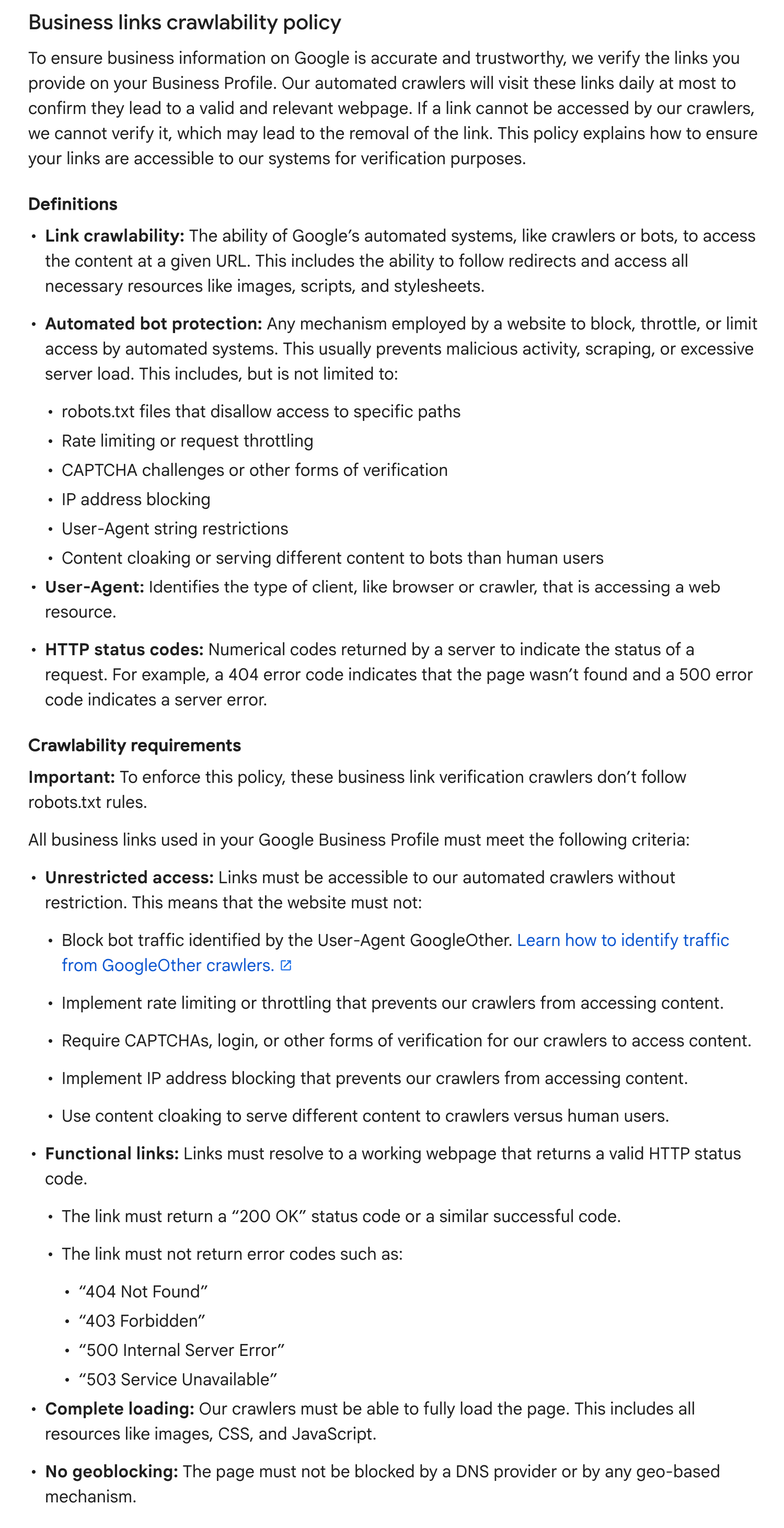
Crawlability Requirements in Brief:
- Links must be fully accessible to crawlers.
- Links must resolve to valid “200 OK” pages, not errors.
- All content (images, scripts, CSS) must load completely.
- Pages must not use geoblocking or DNS restrictions.
- Robots.txt rules are not followed by verification crawlers.
These changes emphasize Google’s focus on ensuring that business profile links are trustworthy, functional, and directly beneficial for customers.
More details and screenshots of the updated guidelines are available in the official support document and on LinkedIn.


